September 21, 2026==
Outstanding Creator Awards Review
Score: 96/100 (9.6 out of 10)
We’re constantly finding reasons to be impressed with Dr. David A. Falk’s works—from his thought-provoking science-fiction novels, including Reliquary of the Dead, All the Stars as Angels, and the sprawling War of the Gods series, to Egg Hunter, the delightfully unexpected video game he created with Kiara Falk and Lagomorph Rampant Studios. What was always apparent in reviewing Falk’s work is that he is a really fascinating, intelligent, and inquisitive person with a keen interest in archaeology, ancient history, mysteries, discovery, and hidden secrets! He’s like a real-life Indiana Jones!
In all of Falk’s works, there’s always been something deeper beneath the surface, something waiting to be discovered, uncovered, and better understood. And that brings us to his ultimate work, his masterpiece, his magnum opus: The Ark of the Covenant in Its Egyptian Context: An Illustrated Journey!
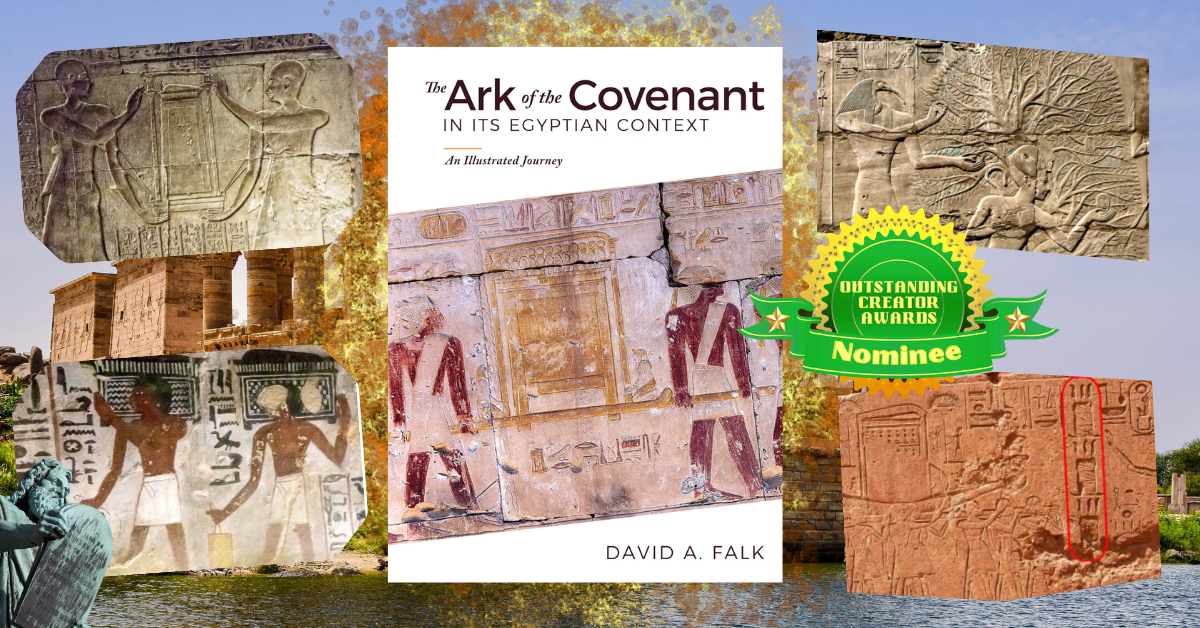
Quite frankly, this might be the strongest book in our 2026 Clash of Champions contest so far. The amount of research that must’ve gone into this is mind-boggling! The thought and effort behind it is mindblowing! And it’s so well put together: text, citations, diagrams, illustrations, and all!
Coincidentally, it’s neck and neck with another archaeological masterpiece in Chariot Kings: Recovering the Lost Kingdom of Mitanni by R Jay Driskill. Both works are phenomenal glimpses into the past–piecing these histories together using the fragmented remnants we have available to us today. That’s no small task!
Now, before you click away because you see the words “Ark of the Covenant” and think, Gosh, this is gonna be another one of those books using pseudoscience or pseudohistory to prove/disprove Christianity or Abrahamic religions, think again! This book takes a very unbiased, evidenced-based approach–impressively so!
Falk is not seeking to prove anything. He’s not trying to argue a point–for or against the existence of the Ark of the Covenant (though he does draw evidence-based conclusions). That’s a relief. Because it always seems like everyone else has an agenda. Even those who argue for the existence of the Ark, or who even claim to have it or know where it is, always seem to do so with ulterior motives. For example, in Ethiopian religious and historical tradition, the Ark is an enormous source of national pride. For the Christian apologists, Ron Wyatt’s claims of the Ark being below Jerusalem and having come in contact with dripping the blood of Jesus can definitely add a spark to a person’s faith.
But this book isn’t specifically about faith. It’s not about a predetermined conclusion. It’s about being unbiased and open-minded to where the evidence leads.
That open-mindedness shows up again and again throughout the book. Falk is perfectly willing to challenge ideas that are popular among religious readers when he believes the evidence points elsewhere. For example, he rejects the commonly promoted early date for the Exodus and instead argues for a later, Ramesside-era setting, drawing on the existence of places such as Ramesses, Pithom, and Migdol, the Merneptah Stela, Egyptian chronology, and other archaeological evidence. He even notes that some defenders of the early date have tried to explain away the name “Ramesses” through later editing, but Falk finds those attempts unconvincing.
At the same time, he doesn’t swing to the opposite extreme and use Egypt to “debunk” the Bible either. Quite the contrary. Falk argues that the Ark makes more sense when understood within the Egyptian world from which the Israelites emerged. Chests, shrines, barques, palanquins, winged protective figures, and portable sacred spaces all provide context for understanding the Ark’s design. But rather than reducing the Ark to a cheap copy of Egyptian religion, Falk shows how those familiar visual ideas could have been adapted and transformed into something distinctly Israelite. By the end, he describes the Ark as something that simultaneously resembles a shrine, coffin, reliquary, throne, and processional object, while still being its own thing.
And then there is the question everyone wants answered: Where is the Ark now? Falk could have milked that mystery for all it was worth. He could have pointed toward Ethiopia, a secret chamber beneath the Temple Mount, some hidden cave, or another sensational theory. Instead, his conclusion is almost aggressively unromantic. It’s scientific.
Dr. Falk is a real-life, genuine Egyptologist! A consumate professional.
That professionalism matters because this is exactly the kind of subject that practically begs to be sensationalized. Instead, Falk repeatedly chooses the less flashy answer when he believes it is the better-supported one. He notes that the Ark is still mentioned during the reign of King Josiah, which works against the idea that it had already disappeared centuries earlier into Ethiopia or elsewhere. And when he finally tackles the question of what happened to it, he does not give us a secret chamber, a hidden monastery, or an archaeological treasure hunt. His conclusion is that the Ark was most likely destroyed in connection with the Babylonian conquest, its wooden structure burned and its gold recovered, melted down, and reused.
That conclusion is almost hilariously anticlimactic compared with the legends surrounding the Ark. But that’s exactly why we respect it. Falk doesn’t seem interested in making the answer exciting. He seems interested in making it make sense. And that same mentality drives the entire book.
Rather than pursuing answers like “Does the Ark actually link humanity with God (or a god)?” or “Does the Ark grant the owner magical powers, good fortune, prosperity, or political authority?,” Dr. Falk is more interested in helping readers to gain context behind the Ark from a purely educational standpoint.
Why is the Ark described the way that it is? Why was it made from acacia wood and overlaid with gold? Why did it have carrying poles? Why were cherubim placed on top? Why was the sacred space associated not with the inside of the chest, but with the area above it, between the cherubim? And why does this strange piece of furniture seem to share characteristics with so many other ancient objects while never quite matching any one of them exactly?
Those are the kinds of questions Falk wants us asking. To answer them, he basically teaches us how to read an ancient visual language that most modern readers no longer understand. Egyptian religion communicated meaning not only through words, but through furniture, architecture, symbols, placement, materials, and ritual space. Chests could carry one kind of meaning. Shrines another. Barques another. Palanquins, thrones, veils, winged figures, and layered sacred spaces all communicated ideas that people living in that world would have recognized almost instinctively.
That is where this book becomes so fascinating. Falk does not argue that the Ark was simply copied from one Egyptian object. Quite the opposite. He shows how it seems to draw from several different forms of Egyptian ritual furniture at once. It is chest-like, shrine-like, throne-like, reliquary-like, and processional. By the end, Falk describes the Ark as a kind of miniature portable temple, carrying sacred space with it wherever it went.
One of the best analogies in the entire book compares this concept to space travel. An astronaut cannot simply step onto the moon and survive in its natural environment. He has to bring a little piece of Earth’s environment with him: oxygen, pressure, temperature control, protection. Falk argues that Egyptian shrines and sacred barques worked in a somewhat similar religious way. They created a protected capsule of sacred space that allowed a divine image to move through the ordinary, profane world without leaving the conditions considered necessary for holiness.
That’s such a clever way of explaining an ancient religious concept that could otherwise sound hopelessly abstract. And then Falk shows us the major difference: there is no idol in the Ark. That may be one of the most important observations in the entire book. Egyptian sacred furniture was often designed to house, protect, enthrone, or transport a physical representation of a god. But the Ark contains no statue of Yahweh. There is no little divine figure sitting inside waiting to be fed, dressed, awakened, moved, or cared for by priests. Instead, the holy space is associated with the area above the Ark, between the wings of the cherubim.
In other words, the Ark appears to use a visual language familiar to the ancient world while simultaneously changing the message. The form communicates divine presence, but the absence of an idol communicates something different: this God cannot be contained inside an image. Falk argues that this was a radical departure from the surrounding idolatrous model. The Ark and tabernacle used recognizable conventions of sacred and profane space, but Yahweh’s presence was not bound to a statue. The God of Israel remained voluntarily rather than being symbolically captured or maintained through an idol.
And that is where The Ark of the Covenant in Its Egyptian Context becomes much more than a book about an old golden box. It becomes a book about communication. Falk is showing us how ancient people could communicate enormously complicated ideas about holiness, authority, divinity, protection, covenant, and presence through physical design. The Ark was not important simply because of what it was made from. It was important because of what it meant. And Falk spends this entire book teaching us how to see that meaning again.
Check it out on Amazon!